Most people on Talkliv know the feeling. You're a few messages into a conversation, you want to keep it going, so you ask a question. Then another. Then another. Somewhere around message four, it starts to feel less like talking and more like filling out a form. The other person senses it too, and the energy drops.
Good questions are supposed to pull a conversation forward, not make the other person feel like they're being processed. This guide is about the difference between the two and how to stay on the right side of it every time you sit down to message someone new. If you haven't set up your profile yet, our guide to creating a Talkliv account covers that first step.
Why Questions Turn Into Interrogations
The pattern behind the questions on Talkliv is usually the actual problem, not the questions themselves.
An interview has a specific shape on any messaging platform: one person asks, the other answers, and then the asker moves straight to the next question without reacting to what they just heard. No follow-up, no comment, no "that's interesting, tell me more." Just the next item on the list.
When a Talkliv conversation falls into that rhythm, a few things happen:
-
The person answering starts to feel like they're being evaluated rather than talked to
-
Each answer gets shorter, because there's no incentive to elaborate
-
The exchange feels transactional instead of personal
-
The energy fades, and eventually someone stops replying
The fix on Talkliv isn't to ask fewer questions. It's to change what happens around them.
The Difference Between a Question and a Prompt
A question that sounds like an interview on Talkliv usually asks for information: Where do you work? How long have you lived there? Do you have siblings? These aren't bad questions, but on their own, they request a fact and nothing more.
A question that opens a conversation does something different. It asks for a reaction, a story, or an opinion. Compare:
-
Interview style: "What do you do for work?"
-
Conversation style: "What's the part of your job nobody would guess from the outside?"
Both touch on the same topic, but land very differently. One produces a one-line answer. The other invites the person to think for a second and tell you something specific. That's the shift that matters: asking for a story instead of a fact.
Build on What They Already Gave You
The single biggest fix for interview energy: react before you ask the next thing.
If a member on Talkliv mentions they just got back from a trip, don't immediately pivot to "What's your favorite food?" Stay with what they gave you. Ask what the best part of the trip was. Mention something you noticed in what they said. Use a detail from their message as the hook for your next one.
This does two things. First, it shows you read what they wrote, rather than running down a script. Second, it keeps the conversation threaded together instead of scattering across ten unrelated topics in three messages.
A simple structure that works well on Talkliv:
-
Acknowledge something specific from their last message
-
React to it briefly, in your own words
-
Then ask your next question, tied to what they said
Skipping the first two steps is exactly what makes a Talkliv question feel like it came from a checklist.
Questions That Work
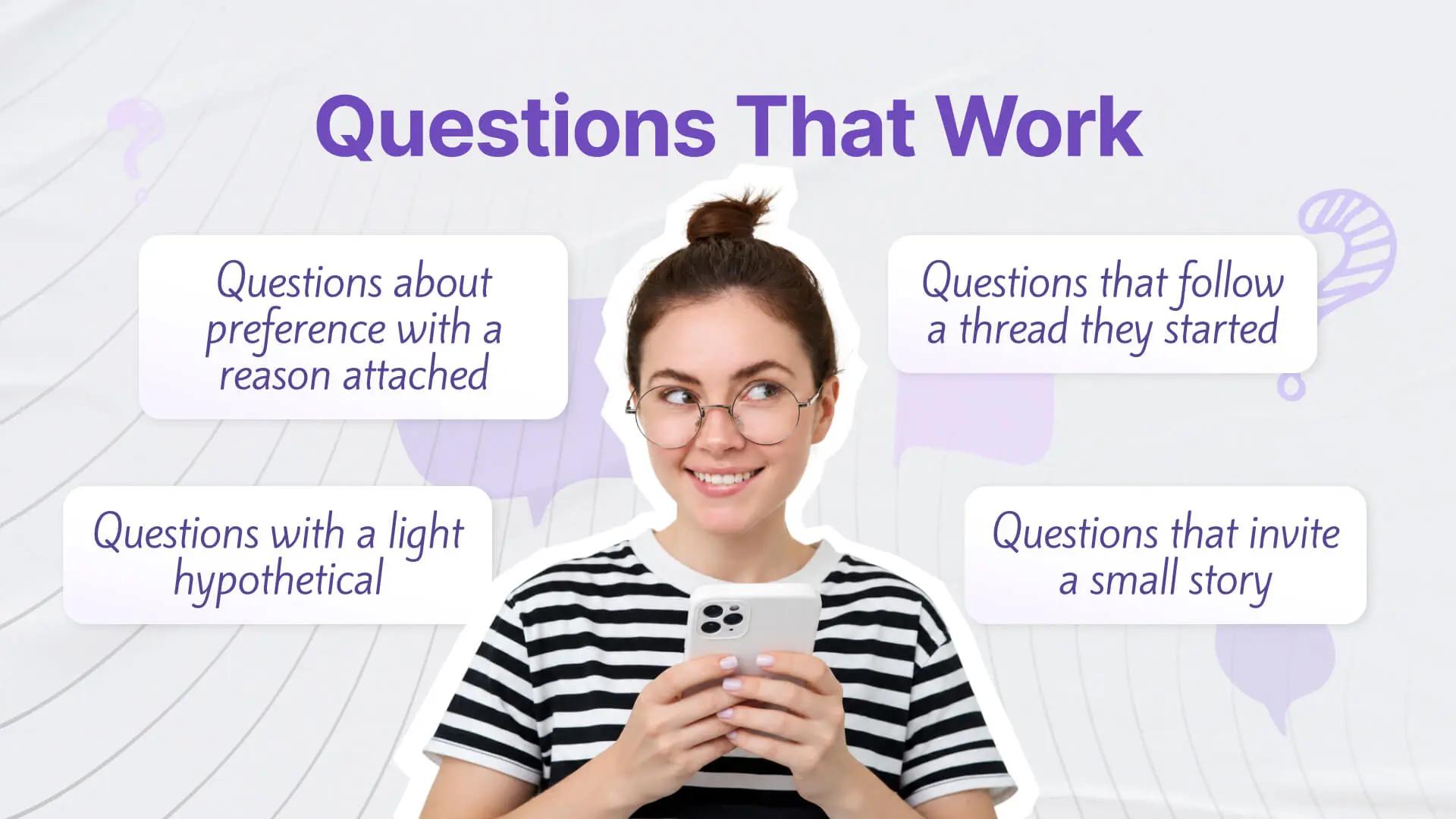
Some questions are naturally better at opening things up than others on Talkliv. A few categories worth having in your back pocket:
-
Questions about preference with a reason attached. Instead of "What's your favorite movie?", try "What movie do you find yourself rewatching, and why does it hold up?" The "why" turns a one-word answer into an actual thought.
-
Questions that invite a small story. "What's something that happened this week that made you laugh?" gets a very different response than "Do you have a good sense of humor?" One asks for a memory. The other asks for a self-assessment, which people tend to answer briefly and vaguely.
-
Questions with a light hypothetical. "If you had an unexpected free weekend, what would you do with it?" is more revealing than "What are your hobbies?" because it forces a concrete answer rather than a list.
-
Questions that follow a thread they started. If someone mentions they're into cooking, "What's the dish you're proudest of making?" goes further than switching topics entirely.
What these Talkliv-friendly questions have in common: none of them can be answered in one word, and all of them give the other person something to work with beyond a flat fact.
Reading the Response, Not Just Collecting It
Part of what separates a Talkliv exchange from an interview is what you do with the answer once it arrives.
A few Talkliv-specific habits that help:
-
Pull out one specific detail from their reply and respond to it directly, rather than reacting generically ("that's cool!") and moving on
-
Notice when someone gives a short answer. It might mean the topic isn't landing, and a different angle is worth trying
-
Match their energy. If they write three sentences, a one-word reply back feels off. If they write one line, three paragraphs back can feel like a lot
-
Let the conversation drift naturally. If their answer opens up a different topic entirely, follow it there instead of steering back to your original plan
None of this requires overthinking every Talkliv message. It just means treating the conversation as something that moves in two directions, not a form you're filling out.
When to Stop Asking and Start Sharing on Talkliv
An interview, by definition, is one-sided on the Talkliv website or anywhere else. One person asks, the other answers. If every message from you is a new question, that's the shape you're building, even without meaning to.
The fix on Talkliv is to share something of your own between questions. If you ask someone on Talkliv what their weekend was like, offer a quick line about yours too, before or after their answer. Ask about their favorite place they've traveled, and mention one of yours in the same message.
This does more than balance the conversation. It gives the other person something to ask you back, which naturally shifts the exchange from a one-way flow to something closer to an actual back-and-forth. On Talkliv, where private messaging and email letters give you room to write something longer, this balance is easy to build in. A short message with one question and one small detail about yourself usually reads far better than a message that's just a question mark at the end.
A Few Practical Notes for Messaging on Talkliv
Since most of this plays out in actual Talkliv conversations, whether through the website or the Talkliv app, a couple of platform-specific points are worth keeping in mind.
-
Icebreakers can be a useful starting point if you're not sure how to open, but they work best as a launchpad, not a script. Once the conversation is moving, build from what the person says rather than sticking to a template.
-
Email letters are a good format when a question deserves more space than a quick back-and-forth allows. If someone gives a longer, thoughtful answer, matching that with a longer reply (rather than a one-line question) keeps the exchange balanced.
-
Photo sharing in conversations can replace a question entirely. Sometimes showing something is more interesting than asking about it; a photo from your day can prompt a more natural question from the other person than a direct ask would.
None of these are strict rules for the Talkliv website specifically. They're just tools that make the underlying approach easier to apply in an actual conversation, rather than in theory. For more on how these features work, our Talkliv FAQ covers the details.
A Quick Example of the Shift
It helps to see the difference laid out side by side. Imagine a member on the Talkliv platform mentions they just adopted a dog.
Interview version: "What breed?" Then "How old?" Then "Do you have other pets?"
Three questions, three short answers, no Talkliv-style exchange. The person answering is doing all the work, and you're doing none of the listening.
Conversation version: "That's great, what made you decide now was the right time?" Then, once they answer: "That's funny, our place growing up was the same way. What's the dog's personality like so far? Has it settled in or is it still figuring things out?"
Same topic, completely different feel. The second version reacts, adds something personal, and asks a question that invites a story rather than a label. It takes maybe ten extra seconds to write, and it changes the entire tone of the exchange.
What This Comes Down To
Asking good questions on Talkliv isn't about having a clever list memorized. It's about paying attention to what the other person just told you and responding as it matters, before moving on to the next thing.
Anyone reading a Talkliv review focused on messaging quality will notice the same pattern: an interview extracts information, while a conversation builds something between two people, one message at a time. The questions matter, but what happens between them matters just as much. Get that part right, and the questions mostly take care of themselves.
Ready to put this into practice? Talkliv is where the conversation starts.