How many accounts did the platform remove last month? How fast did it respond to reports? How many of those reports actually led to action? Some platforms won't tell you. They'll publish a safety page with reassuring language and call it done.
We think that's not enough. A platform that takes safety seriously should be able to show its work: in numbers, over time, without cherry-picking the good parts. That's what a transparency report is for.
This article explains what a Talkliv transparency report contains, why we publish it, and why the numbers matter more than the promises.
Why Transparency Matters on Any Communication Platform
Online platforms handle enormous amounts of human interaction. People share personal information, exchange messages, and build exchanges with others they've never met in person. That comes with responsibility. And responsibility without accountability is just a policy document. At Talkliv, we hold ourselves to a higher standard.
At Talkliv, we believe our members deserve to know more than "we take safety seriously." They deserve to see what that actually looks like: how many accounts were removed, how many reports were processed, how fast we responded, where our systems fell short, and what we're doing about it.
A Talkliv transparency report makes that possible. It's a structured, public account of Talkliv's safety work over a given period: the numbers behind the decisions, the mechanisms behind the moderation, the results behind the effort.
We publish it because every Talkliv member is entitled to it. And because being open about how the platform works, including the hard parts, is the only version of trust worth having.
What a Talkliv Transparency Report Covers
A Talkliv transparency report is not a press release. It doesn't just highlight wins. It's a record of our safety activity across a defined period, presented in a way that members, researchers, and regulators can actually use.
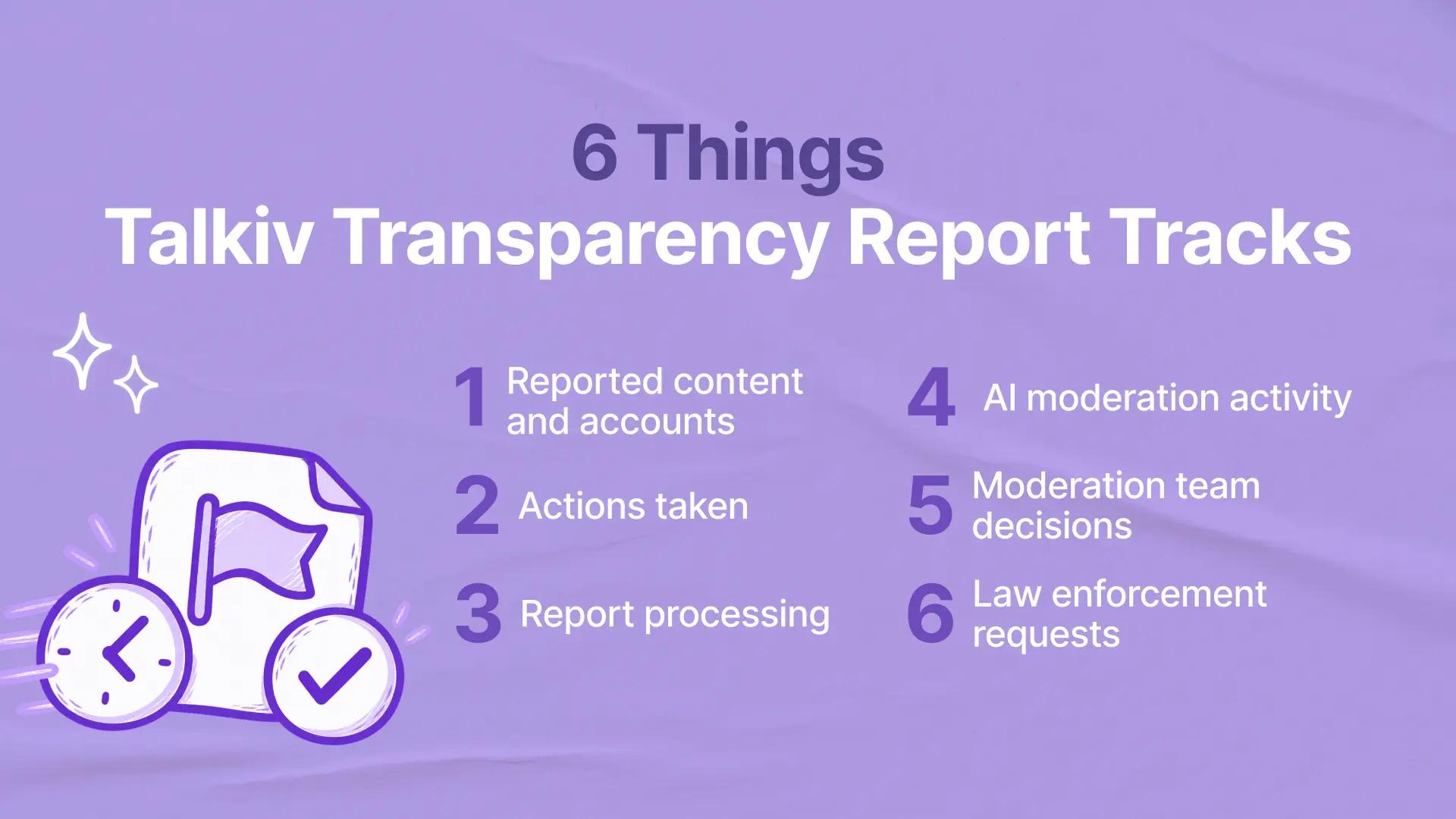
Here's what our Talkliv transparency report covers:
-
Reported content and accounts. How many reports have we received from members, broken down by type: content flagged for a specific violation, or an account reported as a whole for suspicious behavior.
-
Actions taken. How many profiles were blocked or deactivated, and the reasons behind those decisions: spam activity, community guidelines violations, underage indicators, and other categories.
-
Report processing. How many of the reports submitted by members were reviewed, confirmed as valid, and acted on, and how quickly.
-
AI moderation activity. The role our automated systems played in detecting and flagging suspicious profiles before they were ever reported by a member.
-
Moderation team decisions. Cases where human moderators reviewed and classified the outcome, including the proportion of automated flags that were confirmed or overturned.
-
Law enforcement requests. Any formal requests we received from authorities, handled as a separate category with its own transparency.
Each of these categories produces numbers. Those numbers, taken together, form an honest picture of what our safety systems are actually doing. For a closer look at how our reporting and moderation system operates from the member's perspective, our Inside Talkliv's Reporting Tools article provides details.
Why We Started Publishing Transparency Reports
We didn't start publishing transparency reports because it was easy. Our situation at Talkliv demanded it.
Here's what we set out to improve:
-
We wanted to raise the bar on response times. Members submit reports and deserve timely outcomes. We committed to making that faster.
-
We want to stay ahead of bad actors who find workarounds. Underage users don't belong on Talkliv, and our goal is to catch indicators before an account goes live, not after.
-
We don't want fake accounts and spam profiles ruining someone's experience on our platform. Reducing them is an ongoing priority.
None of these challenges is unique to Talkliv. They are challenges that any communication platform of scale has to work through. But acknowledging them publicly, in a transparency report, is what separates a platform that is truly accountable from one that simply claims to be.
Publishing the numbers creates pressure: on ourselves to improve them, on our systems to produce better outcomes, and on our team to keep working even when progress is incremental. But it's also about something else: transparent communication with the people we want to provide value to. Our members deserve to know how we're doing, not just that we're trying.
How We Produce the Data in Our Reports
A transparency report is only useful if the data behind it is accurate. Here's how we produce ours.
AI-driven behavior analysis. Our Talkliv systems monitor profile behavior continuously. Suspicious patterns (atypical activity, signs of spam, or behavior inconsistent with a user's behavior) are flagged and recorded. These flags are the raw data that feeds into our report on automated detection.
Account action records. Every time we block or deactivate a profile, we record the reason. Was it spam? A community guidelines violation? An underage indicator? These records aggregate into the counts we report, so members can see exactly what kinds of problems we're acting on and at what volume.
User report classification. Every report submitted by a Talkliv member is logged and classified. Not all reports are valid. Some reflect misunderstandings, some are frivolous. Classifying each one allows us to report the total volume of reports received alongside how many were confirmed and acted upon. That distinction matters.
Moderation team records. Even with AI tools handling large volumes of flagging, there are cases that require human judgment. Our moderation team reviews and classifies those cases, and their decisions become part of the record too.
Law enforcement tracking. Any formal request from authorities is handled separately and tracked as its own category. We report these even when the volume is low, because transparency here is non-negotiable.
Each layer of data captures an aspect of Talkliv's safety work. Together, they make the report something that reflects daily operational reality, not a curated version of it.
What the Numbers Are Telling Us
Our most recent work at Talkliv.com has produced measurable improvements across key areas:
-
We are responding to spam profiles faster. Detection has improved, and the time between a profile exhibiting suspicious behavior and action being taken has decreased.
-
Member complaints about other users are down 8%. That's a direct signal that the experience on Talkliv has improved in ways members are actually noticing.
-
We are identifying and removing underage users more quickly. We're also actively developing detection capabilities that would identify underage registrations before an account goes live, rather than after.
These improvements have a practical consequence: our moderation team spends less time on clear-cut cases, which means more capacity for the complex situations that require human judgment. The effect compounds. Better automated detection leads to better prioritization, which leads to better outcomes for members.
The Challenges We're Still Working Through
Transparency at Talkliv means reporting what isn't working as well as what is.
The speed and accuracy of report processing on the Talkliv website remain challenges. Response times have improved, but not enough. We're working to reduce the gap between when a member submits a report and when the case is resolved.
Underage detection at the registration stage is not yet where we want it. Our current systems catch a significant proportion of cases, but bad actors adapt. We're developing more sophisticated detection that works on behavioral signals that emerge early in the registration flow, not only on stated age.
Balancing AI moderation with human review is an ongoing calibration. AI scales. Humans contextualize. Getting the handoff right (knowing which cases the AI can handle and which need a moderator) is something we're refining continuously. Our classifier model is being trained on new data specifically to recognize context and slang used by those trying to evade detection, and to better identify the behavioral patterns of spam and bot accounts.
We include these challenges in our Talkliv transparency reports because hiding them would make the reports meaningless. The value of accountability is that it applies even when the news isn't entirely good.
How This Is Different From Simply Updating Our Rules
When we first considered how to be more open about our safety work, we looked at alternatives. Community guidelines updates. Policy announcements. Safety blog posts.
Those have their place. But they don't achieve what a Talkliv transparency report achieves.
Updating rules tells Talkliv members what we expect from them. A transparency report tells them what we're doing: in numbers, over time, across every category of safety activity. Rules don't show whether enforcement is happening. A report does.
Fraudsters, spam accounts, and bad actors also adapt to rules. They read policy updates and look for the gaps. What's harder to game is a platform that combines AI detection, human moderation, and public accountability. The transparency report is part of that combination. It creates an external check on our own systems, because we know the numbers will be read.
What Comes Next for Our Transparency Reporting
We see our transparency reports as a work in progress. Each edition should tell members more, not less.
In upcoming Talkliv reports, we're looking to:
-
Add breakdowns of appeal outcomes: when members contest a decision, what happens, and how often we change course
-
Cover a wider range of our safety team's actions, including newer mechanisms as they come online
-
Incorporate member feedback about what they want to see, because the people using Talkliv every day have a legitimate interest in shaping what we measure and how we report it
Building a safe environment on Talkliv is not a project with an end date. It's a continuous process that evolves as the platform grows, as threats change, and as our capabilities improve. The transparency report is how we show that work to the people it's meant to protect.
Our Talkliv FAQ covers how individual safety features work in practice.